top of page
The stave and an introduction to clefs
LESSONS: 1 THE STAVE 2 CLEFS 3 LEDGER LINES
Once you have learned what the notes in music are, the next step is learning how to place them on the staff or stave as music notes.
A staff/stave is comprised of 5 lines which allow us to place the notes on or between them. Depending on the clef, the position of notes changes, however to make things simple we will learn with the treble clef. The treble clef (also known as the G clef) is the standard clef and most common, with other clefs involving the bass clef, tenor clef and many more. Each clef has a symbol which is placed at the very left of the stave. Each line and space in the stave has a note name, so if a note is placed on this line or in that space, then that is the note! The names, however, change depending on which clef is placed on the clef. Below is an example of a stave with the treble clef (the most common clef) placed on it.


Treble Clef


Bass Clef
Tenor Clef
Information below applies to when reading notes in the treble clef. This is the standard clef for most instruments and for learning how to read and write music.
THE TREBLE CLEF
NOTES ON THE STAVE - LINES
As previously mentioned, every line and space has a name, and the clef which will determine what the note is when placed on the stave. First, we'll start with learning the lines when the treble clef is in place. Starting from the bottom line, we have:
E G B D F
To remember these names, you can make each letter stand for something that you will remember. Some common examples include:
Every Good Boy Does Fine
Every Good Boy Deserves Fruit
Every Girl Bolts During Football
Every Good Burger Deserves Fries
E
G
B
D
F
NOTES ON THE STAVE - SPACES
After you feel comfortable remembering the names of the lines, it's time to learn the names of the spaces! Starting from the bottom space, the notes are:
F A C E
That one is pretty easy to remember, just think of a face! It also helps that FACE and Space rhyme! Just remember that FACE notes are between the spaces! Lets have a look on the stave below to see how this works.
F F F F F F F
A A A A A A A
C C C C C C C
E E E E E E E
F
A
C
E
THE BASS CLEF
The bass clef (also refered to as the F clef) is the second most common clef and is also important to learn.
Instruments such as the bass guitar and piano use this clef to read music. Interestingly, the piano uses a treble clef for the right hand, and a bass clef for the left hand.
Below is a stave with the bass clef symbol planted on it. Take notice of exactly where the clef has been placed, because this is important!

The stave is used in the same way, where notes are placed on both lines and spaces. However the notes change here. An easy way to remember this is that all the notes in the bass clef are moved down to their next line or space. For example, if a note is in a space, it will be moved down to the next space. If a note is on a line, it will be moved down to the next line.
Below is an example of the notes on the lines in the bass clef. The notes are:
G B D F A
G
B
D
F
A
An easy way to remember these note names can be:
Good Boys Deserve Fruit Always
Great Britain Deserves Football Always
Get Bread Don't Forget Apples
Next we need to learn the notes between spaces in the bass clef. These are:
A C E G
A
G
C
E
A A A A A A A
C C C C C C C
E E E E E E E
G G G G G G G
Below is a comparison between the notes with the Treble clef, and the notes with the Bass clef.
TREBLE
E
G
B
D
F
F
A
C
E
D
G

BASS
G
B
D
F
A
A
C
E
G
B
F
You may notice how everything in the Treble clef is moved downwards in the Bass clef. This is an easy way to remember the placement of the notes in the bass clef.
The comparison below shows how the note A has moved down one space in the bass clef. In the treble clef, it was in the second space (from the bottom). In the bass clef, however, it is in the first space (from the bottom), showing how it moved down one space. A better method however is to remember the acronyms for the lines and spaces.

Practice your clefs! The Quizzes page has lots of questions about notes and clefs to help your learning. To access this page, you'll need to sign up as a site member but don't worry - it's totally free! Visit the Quizzes and keep up your practice!
Different instruments use different clefs, however the most common is the Treble clef. This is why it is important to learn these notes. Instruments like the piano, for example, use both the treble and bass clefs! For more information on instruments, please visit the Instrument page. Here you can learn about the history of the instruments and some information about them!
LEDGER LINES
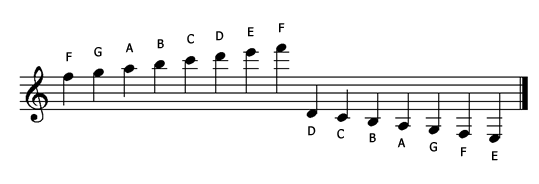
Ledger lines are the lines that you'll see inside the notehead when a note falls under or above the traditional 5 lines of the stave. This will be explained further on the Rhythm page. Below are some examples of notes that use a ledger line. It acts as an extra line on the stave to the initial 5.
See below the third note, A has a line through it. This has a ledger line because it lies outside the range of the stave.
Where the red arrow is pointing is an important note referred to as 'middle C'. This C has a ledger line and is important to remember.
bottom of page